

Pigdon Norgate Family Lawyers | Family Law Insights
What Is DARVO? Recognising Family Violence Tactics in Family Court
By Alana Jacobs, Senior Associate
What Is DARVO?
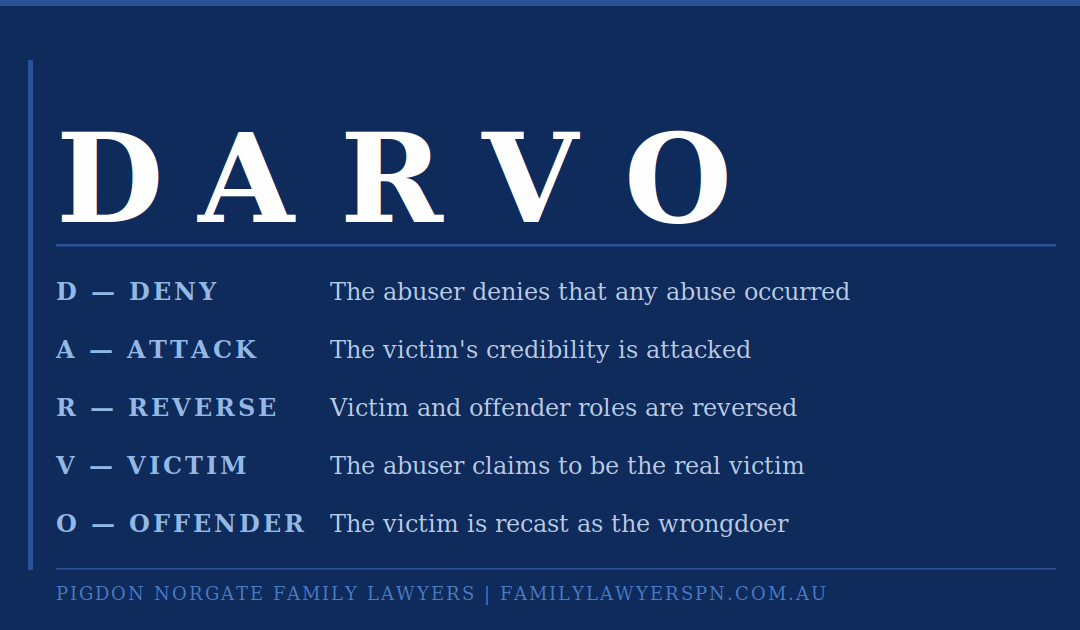
DARVO is an acronym coined by psychologist Jennifer Freyd in the 1990s to describe a structured pattern of manipulation used by perpetrators of abuse when they are confronted or accused. It stands for Deny, Attack, and Reverse Victim and Offender.
The perpetrator first denies that the abusive behaviour ever occurred. Then they attack the credibility of the person making the allegations, often through counter-accusations. Finally, they reverse the roles entirely – portraying themselves as the victim and the person who raised concerns as the aggressor.
Each stage escalates the manipulation. By the time the reversal is complete, the attempt to seek legal protection has been reframed, in the perpetrator’s narrative, as an act of abuse in itself. This is a deliberate and coherent strategy.
How DARVO Looks in Family Court Proceedings
Consider a scenario where one party alleges that the other engaged in coercive control during the relationship. In response, that person may deny the allegations outright (“That never happened”), attack the other party’s character and mental stability (“They are manipulative and unstable”), and then reverse the victim and offender roles entirely (“They are abusing me through the court system by alienating the children from me”).
Taken individually, each of these responses could appear to be ordinary litigation conduct, that is, a denial, a credibility challenge and/or a counter-claim. However, taken together and understood in the context of the relationship history, they reveal something else: a pattern designed to destabilise the other party, shift accountability, and obscure what actually occurred.
How Common Is DARVO in Australian Family Law Proceedings?
The Domestic Abuse Commissioner’s report, Family Court and domestic abuse: achieving cultural change (18 July 2023), found that DARVO is a pervasive feature of contested family law proceedings. A study of Australian legal practitioners found that 55 percent of those surveyed reported that a perpetrator claiming to be the victim ‘Always’ or ‘Usually’ occurs in their experience. A further 41 percent reported that this ‘Sometimes’ occurs. Only 3 percent answered ‘Rarely’.
This means that, in the experience of almost every practitioner surveyed, this reversal of victim and offender is an all too familiar feature of contested family law proceedings involving domestic abuse.
Why DARVO Can Be Difficult to Identify
The challenge with DARVO is that it can superficially resemble legitimate defensive behaviour. A person who has been falsely accused may also deny allegations and challenge the other party’s credibility. Both positions appear credible, unless you investigate further.
What distinguishes DARVO from a genuine defence is pattern, context, and evidence. Practitioners trained in identifying coercive control look for the broader history of the relationship, the nature and timing of counter-allegations, whether those counter-allegations are supported by independent evidence, and whether a consistent pattern of minimisation, blame-shifting, and role-reversal is evident across the proceedings as a whole.
This is why expertise matters. Without it, the pattern can go unrecognised, which can have serious consequences for victims and the children.
The Impact on Victims and Children
When DARVO is not identified and addressed early, victims can be re-traumatised through the very proceedings they commenced for protection. The court process becomes an extension of the abuse, that is, a mechanism through which the perpetrator continues to exercise control after separation.
Children are also at risk. Where a perpetrator successfully frames a protective parent’s behaviour as harmful, for example, by alleging parental alienation in circumstances where a parent is genuinely trying to shield a child from family violence, the children may be placed in situations that compromise their safety and wellbeing.
The Family Law Act 1975 (Cth) requires courts to treat the safety of children as the paramount consideration in parenting matters. Properly identifying and addressing DARVO tactics is central to ensuring that obligation is meaningfully fulfilled, rather than undermined by a manipulated narrative.
What Australian Family Courts Are Doing About It
Awareness of coercive control and its intersection with family law proceedings has grown significantly in Australia. The Family Law Amendment Act 2023 introduced important changes to strengthen the court’s capacity to identify and respond to family violence, with revised definitions that emphasise pattern of behaviour rather than isolated incidents.
Judicial education on family violence, including recognition of tactics such as DARVO, has received greater focus. Research from the Australian Institute of Family Studies and ANROWS (Australia’s National Research Organisation for Women’s Safety) has informed both judicial and practitioner training.
Despite these developments, the litigation remains difficult for victims. Proceedings can be lengthy, costly, and emotionally exhausting. This is particularly the case where a perpetrator is using the process itself as a further tool of control. Early identification of DARVO is essential.
Getting the Right Advice Early Matters
Whether a matter is just beginning or DARVO tactics are already in play, early expert legal advice makes a meaningful difference. Understanding the pattern, building the evidentiary record, and responding strategically (as opposed to rather than reactively) are far easier to achieve when legal representation is in place from the outset.
At Pigdon Norgate Family Lawyers, we have extensive experience acting in family law proceedings involving domestic abuse and coercive control. We understand the dynamics of DARVO and the particular challenges that arise when a perpetrator attempts to use the legal process to continue patterns of abuse established during the relationship.
If you are concerned about these dynamics in proceedings, whether for yourself or someone close to you, we encourage you to contact our office to arrange a confidential consultation.
Support Services
If this article has raised concerns for you or someone you know, specialist support is available:
- 1800RESPECT — 1800 737 732 (24/7 national domestic and family violence counselling service)
- Emergency services — call 000 if someone is in immediate danger
- Men’s Referral Service — 1300 766 491
- NSW Domestic Violence Line — 1800 656 463
This article is intended as general information only and does not constitute legal advice. Family law matters are complex and fact-specific. Please contact Pigdon Norgate Family Lawyers for advice tailored to your circumstances.